
Blog
Wire Rod Sizes & Specifications: Matching Material Geometry with Application Needs
Long before engineers had spreadsheets, tolerances, and CAD software, they had their hands.
They lifted metal, bent it and felt its resistance.
And somewhere between instinct and experience, they learned a quiet truth:
Size isn’t just dimension. It’s destiny.
Because in steel, geometry doesn’t just describe form – it defines behaviour.
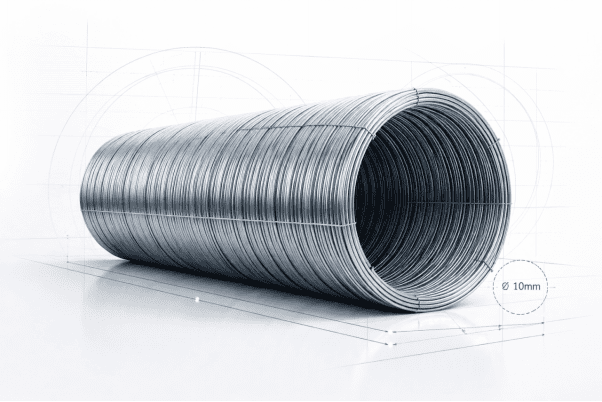
Why Size Isn’t a Number – It’s a Function
We often see wire rod sizes listed like a menu.
5.5 mm.
6 mm.
8 mm.
10 mm.
12 mm.
And so on.
But each of those numbers hides a different story.
A 5.5 mm wire rod doesn’t behave like a 12 mm one.
A tight tolerance doesn’t perform like a loose one.
A coil meant for drawing won’t survive a forging line.
Size affects:
- Load-bearing capacity
- Ductility
- Fatigue life
- Drawability
- Surface finish
- Machining behaviour
- Final component integrity
Pick the wrong size, and even the right grade will fail you.
What Does “Specification” Really Mean?
A wire rod specification isn’t just a dimension – it’s a contract.
It defines:
- Nominal diameter
- Ovality
- Tolerance range
- Surface condition
- Decarburization limits
- Coil weight
- Heat treatment response
- Chemical compliance
And all of these determine what that rod can become.
If you want to understand how composition interacts with geometry, we recommend starting here:
Grades & Chemical Composition
The Diameter Spectrum: Small Changes, Big Consequences
Let’s break this down.
1. Fine Wire Rods (5.5 mm – 6.5 mm)
These are the artists of the steel world.
They stretch.
They draw.
They transform.
Used for:
- Fine wires
- Cables
- Binding wire
- Mesh
- Electrodes
They require:
- Exceptional surface finish
- Tight dimensional tolerance
- High ductility
One micro-defect here becomes a macro-failure later.
2. Mid-Range Wire Rods (7 mm – 10 mm)
This is where versatility lives.
These rods are used for:
- Fasteners
- Automotive parts
- Springs
- Reinforcements
They must balance:
- Strength
- Drawability
- Fatigue resistance
- Process stability
This range carries the highest industrial diversity.
3. Heavy Wire Rods (10 mm+)
These rods don’t adapt – they endure.
They’re built for:
- Structural reinforcements
- Heavy-duty components
- Shafts
- Load-bearing applications
Here, geometry governs:
- Stress distribution
- Bending resistance
- Impact tolerance
Strength without geometry is wasted potential.
Tolerances: The Invisible Engineering
A wire rod doesn’t fail because it’s weak.
It fails because it’s inconsistent.
Tolerances define:
- How round is round
- How straight is straight
- How uniform is uniform
And that consistency is what makes automation possible.
Loose tolerances = more machining = more waste.
Tight tolerances = better fit = longer life.
Geometry Meets Metallurgy
This is where things get interesting.
Diameter affects:
- Cooling rate
- Grain formation
- Residual stresses
- Heat penetration
- Mechanical behaviour
A 5.5 mm rod and a 12 mm rod of the same grade will not behave the same after processing.
Steel remembers its geometry.
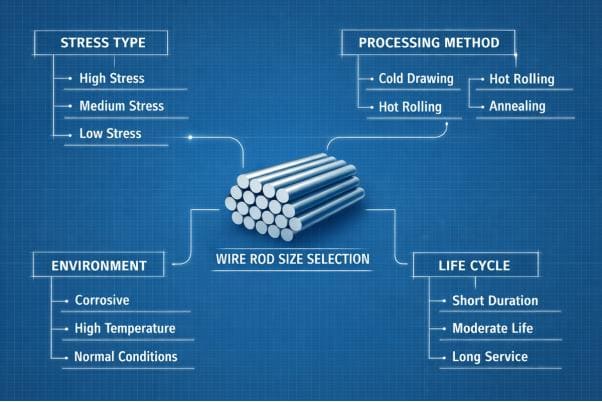
How Engineers Actually Choose Sizes
Not by habit. By logic.
1. What will this rod become?
Wire, bolt, spring, cable, mesh.
2. What forces will it face?
Tension, bending, torsion and vibration.
3. What processes will it go through?
Drawing, forging, rolling, machining.
4. What is the acceptable failure risk?
Zero? Low? Controlled?
Standards: Where Geometry Becomes Law
Sizes don’t exist in isolation.
They are governed by:
- IS standards
- ASTM
- EN
- JIS
These standards don’t just define dimensions – they define performance windows.
At Prime Steels, we don’t design around limits. We design within them.
When Size Is Wrong (Even If Grade Is Right)
This is where most failures hide.
A rod can be:
- Chemically correct
- Mechanically strong
- Heat-treated properly
And still fail because its geometry was wrong.
Failures show up as:
- Premature fatigue
- Uneven wear
- Stress concentration
- Warping
- Processing breakdowns
Steel doesn’t forget its shape.
The Future of Wire Rod Geometry
Next-generation wire rods won’t just be stronger.
They will be:
- More dimensionally stable
- More predictable
- More optimised for automation
- More simulation-friendly
- More sustainable
Smart geometry will become a competitive advantage.
Where Prime Steels Comes In
We don’t just roll wire rods. We engineer proportions.
Our process integrates:
- Precision rolling
- Controlled cooling
- Tight dimensional checks
- Application-first sizing
Explore how our rods are produced:
Process Flow Chart
See our product range:
Wire Rods
Understand our philosophy:
About Us
Final Thought
In steel, shape is not superficial.
It is structural.
It is behavioural.
It is decisive.
And in wire rods, size is not a measurement – it’s a message.
Choose wisely. Design intentionally.
Because geometry is not secondary but foundational.